|
Author
|
|
Mpacker
Michael Packer
Registered: September 2004 Location: Magee Marsh USA Posts: 117
|
|
Review Date: Sun August 3, 2008
|
Would you recommend the product? Yes |
Price you paid?: $320.00
| Rating: 10
|
|
Pros:
|
Inexpensive, 1st rate optics for birding, birding+astronomy+photo scope
|
|
Cons:
|
Not waterproof, movable parts, a tad heavy to other compacts
|
|
I wanted an angled birding scope of Swarovski optical quality that was not as pricey and could be used with the very best eyepieces (EPs) made for astronomy. I 1st bought the angled Pentax 65ED and, although it was nicely priced and waterproof, it was a far cry from a Swarovski 65ED in sharpness. Further, it could not come to focus with one of the best astronomy zoom EPs, the Baader Zoom EP, that, like the Swarovski Zoom EP, gives a comfortable wide field of view.
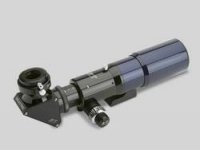
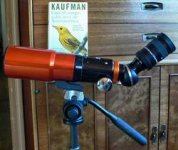
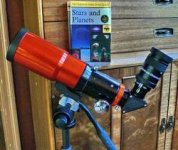
Before I talk about the field test, here is the cost of the scope to set it up for birding (and astronomy). For $400US new, the scope is discount packaged with the very useful 90 degree EP holder (see image 1 and 3) for looking up at star clusters. You can use this diagonal, EP holder, for Birding too, I often do, but note images will be reversed left to right. For $70US more, you can add the 45 degree erecting prism for birding (see image 2). And for $215US you can buy the Baader Zoom (pics 2 and 3). So ~$685US gets you a very affordable 16-48x 66mm birding-astro scope. If you want more power than 48x, you can easily buy any of the astronomy EPs on the market.
Field Tests: The bottom line is that I have compared this scope side by side with the Swarovski 65HD and have found it equal optically. Images are sharp, wide and comfortable to the eye and the 10-1 fine focus offers spot on focus. For $685 vs $2400 that's fantastic and why I rate the scope a 10. Moreover, you can point this scope up at Jupiter, and using EPs that up the power to 100-130x, get beautiful views of the planet's cloud bands. See the forums for more field discussion.
But please keep in mind that this scope is not as rugged or waterproof as high cost spotters. For birding only, Swarovski is tops all around. On the other hand, a non waterproof scope is not really an issue. Semi-sealed optics ie binoculars is where internal fogging becomes a problem. I never have had fogging problems with any of my astronomy scopes, and I live on the humid side of the US where I leave my scopes outside all night at star parties.
Also, the scope is still quite rugged, and has solid feel. But it does have screws that lock down EPs and the focus tube. These screws could possibly work loose during transport and cause an EP to drop out or loose the lock screw.
Anyway, I enjoy the WO66 scope tremendously for birding and would buy the scope even if I did zero astronomy. And the cost savings allows one to get a light weight Gitzo tripod and head :)
Stellar chirps, Michael
------------------------------ Michael
Columbus Audubon Society
Ohio Ornithological Society
|
|
|
|
UTCbirder
Registered User
Registered: April 2008 Location: Port Arthur, Texas Posts: 89
|
|
Review Date: Sun August 17, 2008
|
Would you recommend the product? Yes |
Price you paid?: $348.00
| Rating: 10
|
|
Pros:
|
optical quality: bleeding edge sharp; good close focus, can use astro eyepieces, solid, fine focus ability
|
|
Cons:
|
not H2O proof, "fit together" construction, a little bulky and heavy
|
|
Basically, what Mike said!
I have the Astronomy Tech version of this scope, really the same FPL-51 glass, anodized finish, like that. AT offers the scope in 6 or so colors ("forest green" would be nice for birding use). One minor diff is that the coarse and fine focus knobs are covered in diamond-cut rubber, which is a nice touch, but otherwise the scopes are identical.
The limiting factor in the view of many potential owners of this rig has been the lack of a decent quality, compact, reasonable cost 45-degree erecting prism, but within the last couple of years good multi-coated, BK-4 glass ones from a number of vendors have hit the market. I also have a 1 1/4 dielectric 90-degree mirror star diagonal, but honestly there is not much, if any, performance points in favor of the mirror diagonal. Off axis, maybe a bit more lateral color with the prism, but it's minor and not noticable. In the past, the majority of the right side up, right way round reading diagonals were pretty bad, at least the ones I had looked thru. I use the AT one, which looks like what is shown in Mike's initial posting. Generic versions are available for a slightly cheaper price. Mine ran $69.
The ability to employ various 1 1/4 astro eyepieces is a BIG plus, not to be underrated. Currently on the business end of the scope is an Agena Astro 15mm Super-wide angle, yielding (with the 8% increase in mag the diagonal adds) right at 29X. The ocular runs $42 paid shipping. Specs: fully multicoated, 13mm eyerelief, 70-degree apparent FOV.
THIS IS A FLAT OUT KILLER COMBO! Resolution of fine, feather-level detail, color neutrality/saturation, and especially contast (these scopes have 10 to 13 internal knife edge baffles) is right up there with the very best, period. I also have a Nikon ED82, and prefer the view with the AT 66. Last year, at the local hawk watch site, we AB'd the AT66 and a Swar 65HD. Verdict? A dead heat according to everyone who took the time to look.
Great for the moon and planets too!
HIGHLY RECOMMENDED- a real sleeper product, and one that more birders should consider!
|
|
|
|
|