




Includes Heuglin's Gull, Baltic Gull, Steppe Gull, Taimyr Gull
- Larus fuscus
Identification
Adult: The Lesser Black-backed Gull is a large white-headed gull which comes into contact with (and hybridises with) similar species across its range. Nominate L. f. fuscus or "Baltic Gull" is long-winged with a black mantle and yellow legs in adult plumage.

L. f. intermedius is less elegant, having shorter, broader wings than nominate but longer than L. f. graelsii. L. f. graelsii, the subspecies of North-western Europe, has a slate grey back, paler than both preceding forms. The L. f. heuglini is slightly paler than L. f. graelsii and L. f. barabensis is even paler again.
Younger birds: Lesser Black-backed Gull takes four years to reach full adult plumage, starting with a dark and heavily patterned brown and gradually attaining adult characteristics.
Similar species
It is differentiated from similar Herring Gulls by mantle colour, leg colour, & wing-length, and from Great Black-backed Gulls by leg colour & build.
Distribution
A common and widespread gull in the north of the region. Breeds in Greenland, Iceland, the Faroes and British Isles, in Portugal and north-west Spain and from Brittany to Denmark, coastal Norway and Sweden, inland in Finland and north-west Russia and also on the coast of northern Russia. Some of the subspecies extends further east, with barabensis breeding in the steppes of central Asia.
Northern and eastern populations are migratory with winter range extending from Britain south to North-West Africa and through the Mediterranean to India and South-east Asia.
Occurs on passage over much of Central and Western Europe.
Vagrant north to Svalbard and Bear Island and south to the Azores and Armenia. Used to be considered a Vagrant in especially eastern North America, where it has gradually become more common. Is now a regular vagrant to the Caribbean where for example it is annual in Barbados.

Photo © by Alok Tewari
Dwarka, Coastal Gujarat, India, 27 December 2010
Taxonomy
The Lesser Black-backed Gull is part of a gull clade called the "large white-headed gulls". This includes Yellow-legged Gull, Herring Gull and several other species. Most of these forms started to diverge within the last 500 thousand years. Hybridisation between them is common. The current tendency is to recognise many different subspecies and species. The group's taxonomy is very unstable with very different views between authorities leading to recognition of between 2 and 8 species-level taxa.
Subspecies heuglini is often split as "Heuglin's Gull", L. heuglini. Subspecies barabensis (syn. barbarensis) was formerly considered a race of Caspian Gull and is considered a full species by some ("Steppe Gull").
Subspecies

Clements recognises the following subspecies [1]:
- L. f. fuscus: "Baltic Gull". North Norway, Sweden, Finland to White Sea; winters to Africa, south-western Asia [Dark-mantled]
- L. f. intermedius: Denmark to western Norway, locally south to north-eastern Spain; winters to western Africa
- L. f. graellsii: Iceland, Faeroes, British Isles, France, Portugal; winters to western Africa. [Larger and paler-mantled]
- L. f. heuglini: "Heuglin's Gull". North-western Russia; winters to Middle East, South Africa and south-eastern Asia
- L. f. barabensis: "Steppe Gull". Steppes of central Asia, winters in southwest Asia and western India.
A further subspecies, taimyrensis is not recognised by all authors (often treated as a synonym of heuglini). Conversely, it may be both recognised and elevated as "Taimyr Gull", L. taimyrensis [10] based on plumage differences.
Habitat
Quite catholic in its choice of habitats, perhaps less so than Herring Gulls, Lesser Black-backed Gulls are commonly found nesting on rooftops in coastal towns and cities as well as more traditional areas such as rocky islands and grass-covered tops of mainland cliffs.
In winter these birds can be found amongst mixed species gull flocks both on the coast and inland, often frequenting landfill sites. On passage these birds can occur anywhere.
Behaviour
Diet

Lesser Black-backed Gulls are opportunist feeders, eating anything they can digest and utilising transient food sources. They often use landfills for scavanging during the winter but they will take live prey given the opportunity. This includes molluscs, worms and crustaceans. Like other closely related species, Lesser Black-backed Gulls are omnivorous.
Vocalisation
Listen to Lesser Black-backed Gull voice clip
Gallery
Click on photo for larger image
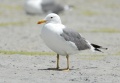
Adult L. f. barabensis
Photo © by AJDH
Al Khobar, Saudi Arabia 24 March 2006
L. f. barabensis,
Photo © by Alok Tewari
Jamnagar, Gujrat, India, 20 January 2016


References
- Clements, J. F., T. S. Schulenberg, M. J. Iliff, S. M. Billerman, T. A. Fredericks, J. A. Gerbracht, D. Lepage, B. L. Sullivan, and C. L. Wood. 2021. The eBird/Clements checklist of Birds of the World: v2021. Downloaded from https://www.birds.cornell.edu/clementschecklist/download/
- Burger, J., Gochfeld, M., Kirwan, G.M., Christie, D.A. & de Juana, E. (2018). Lesser Black-backed Gull (Larus fuscus). In: del Hoyo, J., Elliott, A., Sargatal, J., Christie, D.A. & de Juana, E. (eds.). Handbook of the Birds of the World Alive. Lynx Edicions, Barcelona. (retrieved from https://www.hbw.com/node/53986 on 25 September 2018).
- Collinson, J.M., Parkin, D.T., Knox, A.G., Sangster, G. & Svensson, L. (2008) Species boundaries in the Herring and Lesser Black-backed Gull complex. Brit. Birds 101(7): 340–363.
- Howell, S.N.G. & Dunn, J.L. (2007) Gulls of the Americas. Houghton Mifflin, Boston.
- Malling Olsen, K. & Larsson, H. (2003) Gulls of Europe, Asia and North America. Christopher Helm, London.
- Grimmett, R, C Inskipp, and T Inskipp. 2012. Birds of India, Pakistan, Nepal, Bangladesh, Bhutan, Sri Lanka, and The Maldives, second edition. Princeton, NJ, USA: Princeton University Press. ISBN 978-0691153490
- Burger, J., M. Gochfeld, G. M. Kirwan, D. A. Christie, and E. de Juana (2020). Lesser Black-backed Gull (Larus fuscus), version 1.0. In Birds of the World (J. del Hoyo, A. Elliott, J. Sargatal, D. A. Christie, and E. de Juana, Editors). Cornell Lab of Ornithology, Ithaca, NY, USA. https://doi.org/10.2173/bow.lbbgul.01
- David Boertmann: An annotated checklist to the birds of Greenland, Meddeleser om Grønland (Monographs on Greenland) 1994
- BirdForum Member observations
- Eaton, JA, B van Balen, NW Brickle, FE Rheindt 2021. Birds of the Indonesian Archipelago (Greater Sundas and Wallacea), Second Edition. Lynx Editions. ISBN978-84-16728-44-2
Recommended Citation
- BirdForum Opus contributors. (2024) Lesser Black-backed Gull. In: BirdForum, the forum for wild birds and birding. Retrieved 27 April 2024 from https://www.birdforum.net/opus/Lesser_Black-backed_Gull
External Links

GSearch checked for 2020 platform.1
