




- Luscinia svecica
Identification

13–15 cm (5-6 in)
- Dark brown plumage
- White eyestripe
- White moustachial stripe (reminiscent of a small Redwing
- Red patches on tail sides (all ages)
Male: blue throat, which may have red or white spots depending on the subspecies
Female: throat mainly white with a dark band over the breast
Distribution

Photo © by Alok Tewari
Basai Wetlands, Gurgaon, Haryana, India, March-2018
Main breeding range is in the north and east of the Region, breeds through most of Norway, upland Sweden and north Finland and from Poland and the Baltic States east to the Urals, breeding south to northern Ukraine. Also breeds in very scattered pockets across Europe in Spain and west and central France east to Hungary with an isolated population in the Caucasus and north-east Turkey. Has bred in Britain, Switzerland, Italy and Romania.
A migrant over most of range leaving in August-September to winter around the Mediterranean in small numbers, more commonly in sub-Saharan Africa and the Middle East and returning in March-May. Passage birds occur throughout Europe including Britain where 50-150 occur in most years, mainly on the east coast and Shetland in particular with May and September the peak months.
Vagrants recorded Iceland and Faroes, Ireland and Greece.
Taxonomy
Subspecies

Photo © by PetrValek
North Bohemia, Czech Republic, May 2017

A number of races occur in the Western Palearctic some of which are separable in the field, differing in throat colour of breeding male. The nominate svecica has a blue throat with red central spot and broad black band beneath. Central European cyanecula has white throat spot (or, rarely, none at all), and darker upperparts and namnetum is similar but smaller. South Russian pallidigularis has pale chestnut bar or triangle on paler blue throat and narrower black band and Caucasian magna is similar but larger.
However, there is much individual variation and intergradation between races and isolated pockets of red-spotted birds within range of cyanecula.
There are 12 subspecies[1]
- L. s. svecica: Scandinavia across Siberia to western Alaska; winters North Africa, southern Asia
- L. s. namnetum: Western France
- L. s. cyanecula: Central Europe and Spain; winters to North Africa
- L. s. azuricollis: Northern Spain
- L. s. volgae: North-eastern Ukraine to middle Volga River
- L. s. magna: Caucasus area, eastern Turkey and Iran; winters to Sudan and Ethiopia
- L. s. luristanica: Armenia to south-western Iran; winters to Iraq and the Sudan
- L. s. pallidogularis: South-western Siberia to Turkmenistan, Altai Mountains and upper Yenisey
- L. s. saturatior: Pamir Mountains and Tien Shan Mountains
- L. s.a abbotti: Western Pakistan and north-western India
- L. s. przewalskii: distribution poorly defined (probably is a junior synonym of pallidogularis); breeds Siberia, winters in southern China (Yunnan) and southeastern Asia
- L. s. kobdensis: Western China (Xinjiang)
See this thread for a discussion of Bluethroat subspecies.
Habitat
Breeds on wooded tundra, open birch forest and willow scrub often close to water in thickets beside lakes, rivers and swamps. Out of the breeding season in reedbeds, open grassland and in cultivated areas.
Behaviour
Movement
The Bluethroat is a ground forager when it constantly runs-stops-and-flicks; it also captures insects in the air.
Breeding
Breeds in overgrown wet bushy areas.
Diet
The diet includes insects, caterpillars and berries
Vocalisation
Gallery
Click images to see larger version
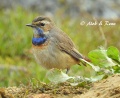
Male in Winter, Ssp. abbotti
Photo © by Alok Tewari
Gurgaon, India, Jan-2017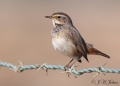
First winter male
Photo © by john-henry
Algarve, Portugal, November 2009


References
- Clements, J. F., T. S. Schulenberg, M. J. Iliff, T. A. Fredericks, J. A. Gerbracht, D. Lepage, S. M. Billerman, B. L. Sullivan, and C. L. Wood. 2022. The eBird/Clements checklist of Birds of the World: v2022. Downloaded from https://www.birds.cornell.edu/clementschecklist/download/
- Gill, F, D Donsker, and P Rasmussen (Eds). 2023. IOC World Bird List (v 13.2). Doi 10.14344/IOC.ML.13.2. http://www.worldbirdnames.org/
- Birdguides
Recommended Citation
- BirdForum Opus contributors. (2024) Bluethroat. In: BirdForum, the forum for wild birds and birding. Retrieved 27 April 2024 from https://www.birdforum.net/opus/Bluethroat
External Links

GSearch checked for 2020 platform.
