




- Dendrocopos major
Picoides major
Identification
Length 23-26 cm (9-10¼ in), wingspan 38-44 cm, weight
- Glossy black upperparts
- White on the sides of face and neck
- Large white shoulder patch
- Barred black and white flight feathers
- Three outer tail feathers barred
- Buffish white under parts
- Crimson lower abdomen and undertail coverts
- Slate black bill
- Grey legs
- Male has a crimson spot on nape, which is missing on the female
- Immatures also have no nape spot, but the crown is crimson

Similar Species
Very similar to the Syrian Woodpecker of southeastern Europe and southwestern Asia, differing most obviously in the moustachial stripe extending back across the lower cheek to the rear of the crown. Juveniles with a red forecrown can be confused with Middle Spotted Woodpecker, but have a stouter bill and stronger moustachial stripe.
Variations
Typically the northern subspecies are larger, with shorter, stouter bills, and whiter underparts. The north African subspecies, D. m. mauritanus and D. m. numidus are cream below with a bold chest band, black at the sides and red in the centre, and more extensive red on the undertail coverts and belly. The Canary Islands subspecies, D. m. canariensis from Tenerife is creamy-buff below, and D. m. thanneri from Gran Canaria is more greyish.
Distribution
Resident throughout range but may be irruptive in the north. One of the most widespread and abundant of the spotted woodpeckers, it breeds from eastern Ireland (where a recent colonist), throughout Britain, most of Scandinavia except the far north and the highest mountains, throughout Europe from Iberia (although scarce in southern Spain) to northern Greece, and east to Kamchatka, Sakhalin, Japan, Korea and China.
Also breeds on the Canary Islands, Corsica, Sardinia and Sicily and isolated populations in the Caucasus and in parts of southern Greece and northern Turkey, in Morocco and northern parts of Algeria and Tunisia. Further east the southern limits of range are reached in north-east India, Vietnam and Hainan.
Vagrants have been recorded in Iceland and the Faroes.
Taxonomy
About 14 subspecies are recognised, differing slightly in overall size, bill size and colour of underparts. However there is much intergradation in mainland races and also variation within races.
Subspecies


There are 14 subspecies[1]:
- D. m. canariensis:
- D. m. thanneri:
- Gran Canaria Island (Canary Islands)
- D. m. mauritanus:
- D. m. numidus:
- D. m. major:
- D. m. pinetorum:
- D. m. hispanus:
- D. m. harterti:
- D. m. brevirostris:
- D. m. kamtschaticus:
- Kamchatka Peninsula and northern coast of Sea of Okhotsk
- D. m. poelzami:
- Transcaucasia and southern Caspian region
- D. m. japonicus:
- D. m. cabanisi:
- D. m. stresemanni:
Habitat
Deciduous, coniferous or mixed woodland and forest, parks and orchards, sometimes in large gardens.
Behaviour
Diet
Although the diet usually consists of insects and their larvae, woodpeckers are not averse to preying on young birds in the nest and will smash their way into nest boxes to do this. In areas where woodpeckers are known to be active, a protective sheet of metal may be fitted to the entrance of the box.
Conifer seeds form an important part of the winter diet, particularly in Northern Europe. Cones may be taken to an 'anvil' to assist in the removal of seeds. The 'anvils' may be a hard surface, on which the cone is balanced, or a crevice, either natural, or one which they have prepared themselves, by cutting back the bark to create a crack.
Vocalisation
The call is a loud 'tchk'. The drumming sound is made by the male, using a dead dry tree that generates a good volume, to attract a female. The sound can travel over hundreds of metres in favourable conditions. Feeding uses a much less rapid pecking action and the quieter sound generated can only be heard at close quarters.
Gallery
Click images to see larger version

D. m. pinetorum, female
Photo © by canonman77
Potteric Carr Nature Reserve, South Yorkshire, UK, 31 May 2009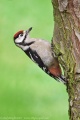
D. m. pinetorum, juvenile. Photo © by Andy Bright
Hertfordshire, England, 6 June 2005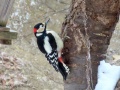
D. m. japonicus, Male
Photo © by Joseph Morlan
Nakashibetsu--Yoroushi Hot Spring, Hokkaido Prefecture, Japan, 22 February 2019


References
- Clements, J. F., T. S. Schulenberg, M. J. Iliff, T. A. Fredericks, J. A. Gerbracht, D. Lepage, S. M. Billerman, B. L. Sullivan, and C. L. Wood. 2022. The eBird/Clements checklist of Birds of the World: v2022. Downloaded from https://www.birds.cornell.edu/clementschecklist/download/
- Gill, F, D Donsker, and P Rasmussen (Eds). 2023. IOC World Bird List (v 13.1)_red. Doi 10.14344/IOC.ML.13.1. http://www.worldbirdnames.org/
- Gorman, G., and S. Kokay (2004) Woodpeckers of Europe: A Study of the European Picidae. Bruce Coleman Books. ISBN 1-872842-05-4
- BWPI Birds of the Western Palearctic Interactive DVD-ROM. Gostours Ltd. ISBN 978-1898110392
- Perktas, U. & Quintero, E. (2013) A wide geographical survey of mitochondrial DNA variation in the Great Spotted Woodpecker complex, Dendrocopos major (Aves: Picidae). Biol. J. Linn. Soc. 108(1): 173–188.
- Winkler, H., Gamauf, A., Nittinger, F. & Haring, E. (2014) Relationships of Old World woodpeckers (Aves: Picidae)—new insights and taxonomic implications. Ann. Naturhist. Mus. Wien. 116: 69–86.
- Winkler, H., Christie, D.A. & Kirwan, G.M. (2019). Great Spotted Woodpecker (Dendrocopos major). In: del Hoyo, J., Elliott, A., Sargatal, J., Christie, D.A. & de Juana, E. (eds.). Handbook of the Birds of the World Alive. Lynx Edicions, Barcelona. (retrieved from https://www.hbw.com/node/56225 on 18 May 2019).
Recommended Citation
- BirdForum Opus contributors. (2024) Great Spotted Woodpecker. In: BirdForum, the forum for wild birds and birding. Retrieved 27 April 2024 from https://www.birdforum.net/opus/Great_Spotted_Woodpecker
External Links

GSearch checked for 2020 platform.1
